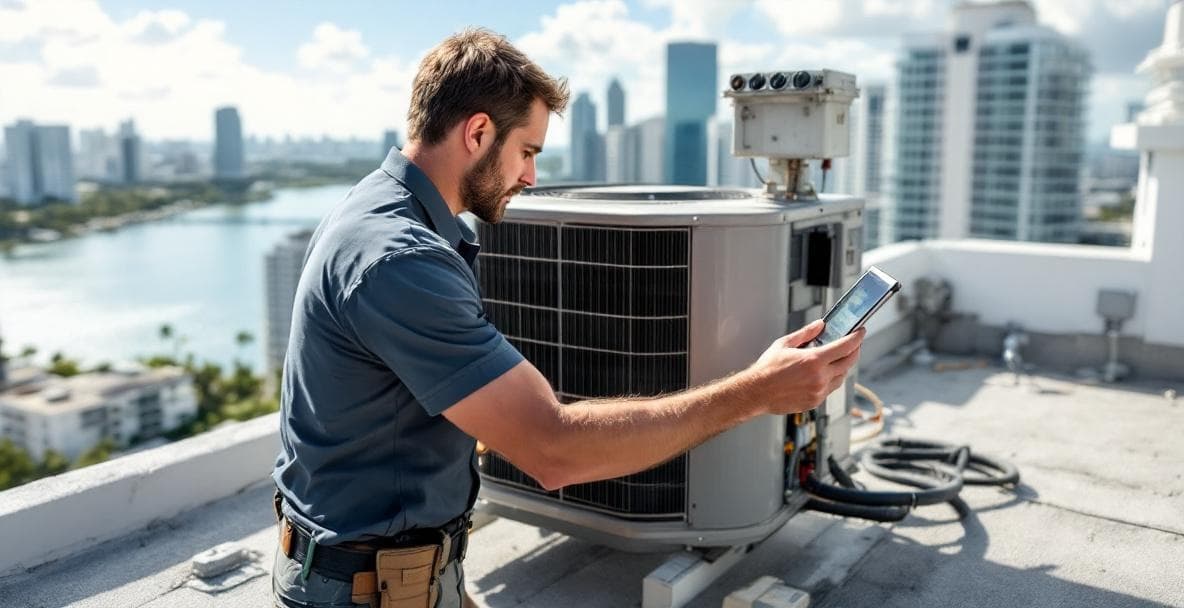
How to Hire an HVAC Contractor in Miami, FL
Miami doesn't give you much warning. One afternoon your AC starts struggling to keep up with 85-degree heat and 90% humidity, and by the next morning you're calling contractors from a home that feels like a sauna. That urgency is exactly when bad decisions happen — rushed quotes, unverified licenses, unpermitted installs that come back to haunt you at closing.
This guide walks you through the whole process: what credentials to check, what the county actually requires, what Miami's climate demands from your equipment, and how to hire someone you won't regret. Consider it advice from a neighbor who's done the homework.
Why Hiring the Wrong HVAC Contractor in Miami Is Especially Costly
Everywhere in the U.S., a bad HVAC hire means discomfort and wasted money. In Miami, it can mean something worse.
During a July heat event, with humidity above 80% and no functioning air conditioning, a home can become genuinely uninhabitable within hours — not just uncomfortable, but dangerous for children, elderly residents, and anyone with respiratory conditions. AC in Miami isn't an amenity. It's infrastructure.
The financial risks compound fast. Unpermitted installations discovered during a home sale in Miami-Dade can halt closings, force a full re-installation, and trigger retroactive permitting fees that far exceed what a legitimate contractor would have charged in the first place. Homeowners who skip license verification also risk voiding their manufacturer warranty, failing county inspections, and having zero legal recourse when something goes wrong.
Then there's the environmental factor most contractors won't volunteer: salt air from Biscayne Bay is corrosive. An outdoor condenser installed without protective coatings near the coast can lose half its expected lifespan. Shoddy equipment placement — too close to a wall, improperly elevated, wrong orientation — accelerates that degradation further.
Add hurricane season (June through November) and the picture gets more complicated. Every significant storm brings a wave of out-of-area contractors chasing repair work across Miami-Dade. Some are legitimate. Many are not. Price-gouging is common, installation quality is inconsistent, and by the time you realize something was done wrong, the contractor is three counties away.
One detail that separates Miami from most other Florida markets: Miami-Dade's High-Velocity Hurricane Zone (HVHZ) building code imposes stricter equipment anchorage standards than virtually any other county in the state. A contractor unfamiliar with HVHZ requirements can install a brand-new unit that looks perfect on the outside and still be non-compliant — leaving you exposed to insurance issues and code enforcement action the next time a storm rolls through.
The Licenses Every Miami HVAC Contractor Must Hold — And How to Verify Them
Before you get into pricing, before you talk brands, ask for credentials. A legitimate contractor will hand them over without blinking.
Florida state license. Florida requires all HVAC contractors to hold a Certified or Registered Air Conditioning Contractor license issued through the Florida Department of Business and Professional Regulation (DBPR). Verify any license in about 90 seconds at myfloridalicense.com — search by name or license number and confirm the license is active and not under discipline. This step is non-negotiable.
Miami-Dade Certificate of Competency. The county adds a second layer that catches a lot of out-of-area contractors operating illegally after major storms. A contractor licensed to work in Broward County or Palm Beach County is not automatically authorized to work in Miami-Dade. The local Certificate of Competency is a separate credential issued by the county. You can verify a contractor's county certificate and check for any complaints through Miami-Dade's Contractor Inquiry & Complaint Search, accessible from the Building Online Services page at miamidade.gov/global/economy/building/online-services.page. Ask for that certificate number and look it up before they arrive — the same way you would the state license.
EPA Section 608 certification. Any technician who handles refrigerants — recovery, recharge, or replacement — is federally required to hold EPA Section 608 certification. Ask to see this before any refrigerant-related service begins.
One specific scam to watch for: a contractor who offers to pull permits "in the homeowner's name." This usually means they can't pull permits under their own credentials — because those credentials don't hold up. When permits are pulled in your name, liability for any code violations transfers to you, not them.
The practical routine: ask for the state license number and the Miami-Dade Certificate of Competency number at your first call. Check the state license at myfloridalicense.com and the county certificate through the Contractor Inquiry search at miamidade.gov. Confirm the name on both licenses matches the company name on the quote. These steps eliminate a large share of bad actors before the job ever starts.
HVAC Permits and Inspections in Miami-Dade: What the County Actually Requires
Here's something a surprising number of Miami homeowners don't know: replacing an existing AC unit — a straight swap — still requires a permit in Miami-Dade. This is not a new installation technicality. Equipment replacements require permits. Anyone who tells you otherwise is either misinformed or hoping you won't find out until it's too late.
All permit applications go through Miami-Dade's permitting system. A legitimate contractor handles the submission on your behalf — you should receive an actual permit number before any work begins. If a contractor starts work without providing that number, stop the job.
After installation, a county inspector must sign off on the work. If your contractor discourages you from scheduling the inspection, says inspections aren't required for your type of job, or tells you to schedule it yourself after they've already left — those are red flags serious enough to reconsider the entire relationship.
The consequences of skipping inspection aren't hypothetical. Unpermitted work discovered during a home sale, an insurance claim after storm damage, or a code enforcement visit can result in a mandatory tear-out and reinstallation at the homeowner's full expense. The original contractor is often unreachable by that point.
Miami-Dade gives you a useful self-check tool: you can search your own address to confirm a permit was issued and closed. Use the Building Permit Selection Menu at miamidade.gov/permits/online-services.asp to search by address. If your contractor claimed to have pulled a permit and nothing shows up, you have a problem worth addressing before more time passes.
Homeowners in Coral Gables and Miami Beach should also note that those municipalities may layer additional local inspection requirements on top of county requirements — confirm this with your contractor before work begins, since it can affect timeline and cost.
What Miami's Climate Demands from AC Equipment
Most of the continental United States runs its AC hard for three, maybe four months. Miami runs it ten to twelve months per year. That changes what equipment you actually need.
Sizing and dehumidification. Miami's wet season runs June through October, with daily humidity that regularly exceeds 80% and afternoon thunderstorms that keep conditions saturated. An undersized system, or one without strong dehumidification capacity, will run constantly and still leave rooms feeling muggy — which is both uncomfortable and a setup for mold growth in ductwork and air handlers. Don't let a contractor talk you into a system based on square footage alone; load calculations need to account for ceiling height, window exposure, and insulation quality, especially in older Miami homes.
Corrosion protection near the coast. For homes near Biscayne Bay, the Coconut Grove waterfront, or anywhere along Miami Beach, salt air is a genuine threat to outdoor condensing units. Aluminum fins and electrical components corrode faster in coastal environments. Industry experience suggests an uncoated condenser coil that might last 15 years inland can fail in fewer than 7 years in Miami's salt air — and that's not a warranty situation, it's a wear situation. Ask contractors specifically about corrosion-resistant coatings such as Blygold or factory-applied phenolic coatings. A protective coating typically runs $200–$400 at installation time and is worth it.
Ductwork in older homes. For concrete-block homes common in Little Havana, Hialeah, and Coral Gables, the ductwork condition often matters more than the unit itself. A new, efficient system connected to leaky 30-year-old ducts is wasted money — conditioned air bleeds out before it reaches the rooms you're trying to cool. Any honest contractor should assess duct integrity as part of the quote process, not just size the new unit.
Condo and high-rise systems. High-rise owners in Brickell or Miami Beach frequently deal with multi-zone systems, fan-coil units, or building-managed chilled water systems that require contractors with specific experience. Not every residential HVAC company is equipped for this work — ask directly whether the contractor has completed similar projects in comparable buildings.
Efficiency ratings. SEER2 ratings matter more in Miami than most U.S. markets because the system runs nearly year-round. A higher-efficiency unit that costs more upfront often pays back through lower Florida Power & Light bills within three to five years. Run that math with your contractor, or ask them to run it for you.
How to Get and Compare HVAC Quotes in Miami Without Getting Burned
Three quotes is the floor, not the gold standard. Get three at a minimum, make sure all of them are written, and treat verbal estimates as conversation starters — not contracts.
Each written quote should include: the specific equipment model number, the SEER2 rating, warranty terms broken out by parts and labor, permit fees, disposal of old equipment, and the expected installation timeline. Any quote missing these line items is incomplete, and the gaps are where costs balloon.
The lowest bid is worth interrogating, not celebrating. Low bids commonly exclude permit fees, haul-away of old equipment, or required electrical upgrades that the county may flag during inspection. Ask every bidder to explicitly confirm what is not included in their price. If they can't answer that question clearly, the quote isn't real.
Confirm the quoted equipment is current manufacturer stock — not refurbished, not discontinued inventory. Discontinued units can't always be registered for manufacturer warranty, which matters a lot on an investment of this size. Look up the model number yourself if you need to.
Timing is worth thinking about. Miami HVAC demand surges after major tropical storms, when scores of damaged condensers need simultaneous replacement across Miami-Dade. Emergency pricing during a post-hurricane crunch commonly runs 30–50% above normal rates, and availability of both equipment and qualified technicians tightens dramatically. If you're replacing an aging system that hasn't failed yet, scheduling in March or April — before hurricane season and before peak summer demand — typically yields better pricing and more contractor attention.
One absolute red flag: a contractor who demands full payment upfront before ordering equipment or starting work. A reasonable deposit is standard; full payment before any work begins is not.
Questions to Ask Every Miami HVAC Contractor Before You Sign
Have these ready before your first contractor conversation. Their answers — and their comfort level answering them — will tell you a lot.
"Can you provide your Florida DBPR license number and your Miami-Dade Certificate of Competency number right now?" Hesitation or deflection is a red flag. A contractor who works legitimately in this county has both numbers immediately available.
"Will you pull the permit and schedule the inspection, and can I receive the permit number before work starts?" The answer should be yes, yes, and yes. Any hedging on any part of that question is worth pressing on.
"Is your installation team your employees, or do you subcontract? Will the same technician handle start-up and commissioning?" Subcontracting isn't automatically disqualifying, but you deserve to know who will actually be in your home, and whether the person who installs the system is the same person who verifies it's running correctly.
"What corrosion protection do you recommend for the outdoor unit given our proximity to the water, and is that included in this quote?" A contractor who knows Miami's coastal environment should raise this topic themselves. If they don't, raise it and see how they respond.
"What is your process if the system underperforms or fails inspection — who pays for corrections?" Get the answer in writing. "We'll take care of it" is not a contractual commitment.
"Do you offer a maintenance plan, and does it include coil cleaning and drain line flushing?" In Miami's humidity, drain line blockages cause water damage and mold — this should be part of standard maintenance, not an add-on that appears on your next invoice as a surprise.
One question most Miami homeowners never think to ask: whether the contractor is specifically familiar with HVHZ installation requirements for outdoor condensing units. Miami-Dade's High-Velocity Hurricane Zone code mandates specific anchoring methods, and a contractor who goes blank at the question is probably not the right person for this job.
Maintaining Your AC in Miami: Protecting the Investment Year-Round
The best equipment and the most careful installation only take you so far. In Miami's climate, what happens after installation determines how long the system lasts and what it costs you to run.
Most HVAC professionals serving Miami-Dade recommend bi-annual service: once before summer (typically April or May), and once mid-winter (November or December). Annual service is the minimum; twice a year is realistic for a system running ten or more months out of twelve.
Condensate drain line flushing should happen at every service visit. Miami's humidity means drain lines clog faster than in most markets — a blocked drain backs up into the air handler, causes water damage to ceilings and walls, and creates the moisture conditions mold needs. This is not a luxury maintenance item.
Coil cleaning removes the biofilm, dust, and organic material that accumulate in humid air and force the system to work harder than it should. A dirty coil raises electricity consumption on a system that's already running most of the year.
After any named storm passes through Miami-Dade, inspect the outdoor unit before restarting it. Check for debris contact with refrigerant lines, any visible damage to the cabinet or fins, and verify the unit is still properly mounted and level. Power surges during Miami's frequent afternoon thunderstorms also cause compressor and control board failures — a surge protector on the condensing unit is cheap insurance.
Document every service visit with a dated invoice. That paper trail supports warranty claims if a component fails, and it demonstrates to future buyers that the system was maintained — which matters in a Miami real estate market where buyers scrutinize HVAC condition closely.
Florida Power & Light serves most of Miami-Dade and periodically offers rebates on qualifying high-efficiency equipment — ask your contractor at quote time since equipment must meet specific SEER2 thresholds to qualify. Current program details are available at fpl.com/save (programs change; confirm with FPL directly before purchase). Miami-Dade County and federal weatherization assistance programs have also historically offered income-qualified support for HVAC upgrades; contact Miami-Dade's Community Action and Human Services Department for current options.
FAQ
How much does a new AC unit cost installed in Miami?
Installed costs vary widely based on system size, equipment brand, and whether electrical or ductwork upgrades are needed. As of time of writing, contractors in the Miami market commonly quote $4,000–$8,000 for a standard central air replacement on a single-family home, with high-efficiency or larger systems running higher. Prices can shift with equipment availability and demand — always get itemized, written quotes so you can compare what's actually included.
How long does an AC system typically last in Miami's climate?
Industry benchmarks suggest 12–15 years for a properly maintained central AC system in most U.S. markets. In Miami, the combination of year-round operation and coastal corrosion can shorten that range — systems near the coast without protective coatings often show significant degradation in under ten years. Quality installation, a protective coil coating, and consistent bi-annual maintenance are the main factors that extend lifespan here.
Can a contractor from Broward or Palm Beach work in Miami-Dade without a local license?
No. Miami-Dade requires its own Certificate of Competency in addition to the Florida state DBPR license. A contractor licensed to work in Broward or Palm Beach County is not automatically authorized to operate in Miami-Dade. You can verify county credentials through the Contractor Inquiry & Complaint Search at miamidade.gov/global/economy/building/online-services.page. After major hurricanes, out-of-area contractors who don't hold this county credential frequently work illegally in the area — verifying both licenses protects you.
What happens if my HVAC contractor didn't pull a permit and the work is already done?
You'll need to address it — the longer you wait, the more complicated it gets. Options typically include hiring a licensed contractor to submit a retroactive permit application (which triggers an inspection of the existing work), or in the worst case, having non-compliant work torn out and redone. Costs and process vary; contact Miami-Dade's building department directly at miamidade.gov/permits for guidance on your specific situation.
Does homeowners insurance cover AC replacement after hurricane damage in Florida?
It depends on your policy. Many Florida homeowners insurance policies cover sudden damage from a named storm but exclude equipment breakdown or gradual wear. Review your policy's windstorm and mechanical breakdown provisions, and document any storm damage with photographs before cleanup begins. Filing a claim without documentation often leads to disputes over cause of loss.
How do I know if my AC is big enough to handle Miami humidity?
If your system runs constantly during humid months but rooms still feel sticky, undersizing or poor dehumidification capacity is a likely cause. A qualified contractor should perform a Manual J load calculation — the industry-standard method — rather than sizing purely by square footage. If a contractor gives you a unit size recommendation without asking about ceiling heights, window count, insulation, or orientation, push back.
Are there rebates that help pay for AC replacement in Miami-Dade?
Florida Power & Light offers efficiency rebates on qualifying equipment — ask your contractor at quote time since the equipment must meet specific SEER2 thresholds, and confirm current availability at fpl.com/save. Miami-Dade County and federal weatherization assistance programs have also historically offered income-qualified support; contact Miami-Dade's Community Action and Human Services Department for what's currently available, as programs change.
How soon can I get an HVAC contractor after a hurricane in Miami?
Availability collapses fast after a major storm. Established local companies typically prioritize existing maintenance contract customers first — one practical reason to have a service relationship before a storm hits. Wait times for non-priority calls can stretch from days to weeks after a significant event. If you're quoted an unusually high price immediately post-storm, get a second opinion when possible — price-gouging after declared emergencies is illegal in Florida, and the Attorney General's office accepts complaints.