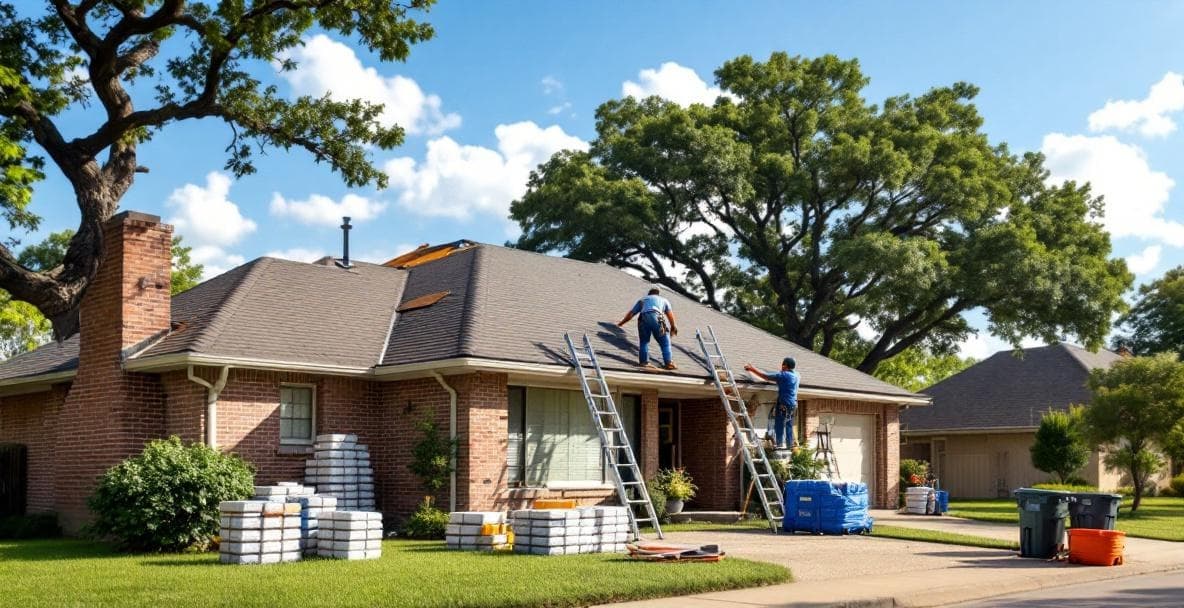
Hiring a Roofer in Dallas, TX: What Homeowners Must Know
Dallas is one of the toughest roofing markets in the country — not because contractors are uniquely bad here, but because the conditions that create roofing work are relentless, and where there's volume, there are shortcuts. Golf-ball hail, 105°F summers, and February ice storms give your roof no off-season. What follows is everything a Dallas homeowner needs to hire the right roofer, verify their credentials, read a bid, and protect themselves through an insurance claim — without needing a roofing background to do it.
Why Dallas Roofs Take More Punishment Than Most
Dallas averages 37 to 39 inches of annual rainfall, but the number undersells the violence of how it arrives. The Metroplex sits in North Texas's primary hail corridor, where supercell thunderstorms track across the region from March through June, delivering hail that has reached golf-ball size across multiple neighborhoods in a single season. That's not a once-in-a-decade event — it's a recurring pattern that drives mass insurance claims from Preston Hollow to Farmers Branch every few years.
Beyond hail, the summer UV index regularly hits 10 to 11, quietly degrading asphalt shingles faster than the national average. Shingles that look intact may be losing granule coverage and flexibility year over year. Then winter arrives — and February 2021 reminded every Dallas homeowner what a hard freeze can do to flashing, sealants, and underlayment that was already stressed. The ice load cracked joints, separated membranes, and exposed failures that were months in the making.
Flat and low-slope roofs in older inner-loop neighborhoods face their own problem: convective rainfall events arrive fast and heavy, overwhelming drainage systems designed for a slower era. And the back-and-forth of 100°F-plus summers into hard freezes puts every penetration, joint, and seam through thermal cycling that compounds damage across years.
A roof that looks fine in October may be hiding six months of cumulative storm damage. That's not alarmism — it's the reality of what this climate does to building envelopes, and it's why hiring the right contractor matters more here than in most U.S. cities.
What 'Licensed' Actually Means for Dallas Roofers (It's Complicated)
Here is the fact that catches most Dallas homeowners off guard: Texas has no statewide roofing contractor license. Any individual can legally call themselves a roofer at the state level. That's not a loophole — it's the law, and storm chasers know it.
What exists locally is more useful. The City of Dallas requires roofing contractors to hold a General Contractor registration through the Sustainable Development and Construction Department. That registration number should appear on any bid or contract you receive. Before you sign anything, verify it directly through DallasNow, the city's online permitting portal (accessible at dallascityhall.com). In-person registration and verification is handled at 320 E. Jefferson Blvd., Room 118, Dallas, TX 75203. This takes a few minutes and filters out a significant share of unqualified operators, because transient storm crews rarely bother registering with local municipalities they don't plan to stay in.
Beyond registration, manufacturer certifications — GAF Master Elite, Owens Corning Platinum Preferred — are voluntary but meaningful. They require documented training, minimum installation standards, and ongoing accountability. They're not a guarantee of quality, but they signal a contractor who's invested in their trade rather than just chasing the next storm.
Insurance documentation is non-negotiable. Ask for certificates of general liability and workers' compensation insurance, and ask that you be named as an additional insured. If a worker is injured on your property and the contractor carries no workers' comp, you may be exposed to liability. Uninsured crews are common in the weeks following a major Metroplex storm event — and a low bid from an unverifiable contractor can end up costing far more than the savings.
Permits, Paperwork, and Why Skipping Them Hurts You
Dallas requires a building permit for full roof replacements. The contractor pulls it through DallasNow — not you — and it should be treated as a standard cost of doing business, not a special accommodation.
A contractor who suggests skipping the permit is not doing you a favor. They're saving themselves time and administrative hassle while transferring risk entirely to you. Here's what that risk looks like in practice:
If you file a future storm damage claim, your insurer can deny coverage on the grounds that the prior replacement was unpermitted and therefore unverified. When you sell the home, a buyer's inspector or lender can pull the permit history by address through DallasNow. Unpermitted work surfaces in that search. It can kill a sale outright, force retroactive permitting at your expense, or require a contractor to tear into finished work to verify what was done. The liability follows the property, not the contractor who took the shortcut.
Ask for the permit number before work begins. Legitimate contractors pull permits as a matter of course — it is not a special request. If the response is hesitation or an explanation of why it's not necessary, that's your answer. Permit inspections also provide an independent review of workmanship, which protects you if there's a dispute down the road.
How Dallas Hail Season Changes the Hiring Game
From March through June, the Metroplex is on storm watch. When a significant hail event tracks through — and golf-ball-sized hail has been documented across multiple events in recent years, hitting neighborhoods from Lake Highlands to Oak Cliff to Lakewood in a single season — contractor demand can spike five to ten times within 48 hours.
That surge is when out-of-state storm-chasing crews arrive. They come in volume, they work fast, and many are gone before warranty claims arise. They are often unregistered, uninsured, and operating under business names that won't exist in six months. They knock on doors in affected neighborhoods — Lake Highlands and Farmers Branch see this heavily after confirmed storm tracks — applying pressure to sign on the spot.
Texas law requires contractors soliciting storm-damage repair to provide a written contract and disclose a physical business address. Not a PO box. Not an out-of-state address. A real local location. That requirement is routinely ignored by crews who know they'll be gone before anyone complains.
Do not sign a contract the day someone knocks on your door, regardless of what they offer. Take 24 to 48 hours. Verify their Dallas registration through DallasNow. Check their reviews — specifically, look for reviews that predate the most recent storm season. A contractor who accumulated five-star reviews after the last hail event may have manufactured them. One with a consistent review history going back two or three years is a different situation.
Navigating Your Insurance Claim Without Leaving Money on the Table
Before any contractor gets on your roof, document the damage yourself with dated photos. This protects you if an insurer later disputes when the damage occurred or whether it predated a certain event.
Your insurer will send an adjuster to assess the damage. You have the right to have your contractor present during that inspection. A knowledgeable contractor can walk the adjuster through damage that a desk review might miss — granule loss patterns, flashing separation, underlayment exposure at valleys. Their presence often results in a more complete scope of loss.
On the deductible: Texas HB 2102 (86th Legislature, 2019), codified as Texas Insurance Code §707.002, makes it illegal for a roofing contractor to waive, absorb, or rebate your insurance deductible as an inducement to sign a contract. Violations are Class B misdemeanors carrying up to a $2,000 fine and 180 days in jail. Any contractor who offers to "cover your deductible" or says "you won't have to pay anything out of pocket" is breaking the law. The Dallas Metroplex was among the highest-volume markets that drove the legislature to enact this statute — this is not an obscure rule. Treat the offer as a disqualifying red flag, not a bargain.
Once you have the insurer's written scope of loss — the Xactimate report — compare it line by line against your contractor's bid before authorizing any work. Gaps between the two need to be explained and resolved before the project starts. Supplementing, which means asking the insurer to cover additional damage found during tear-off, is legitimate and routine. A reputable contractor handles it transparently and keeps you informed throughout.
If your claim is underpaid or denied, you can engage a licensed public adjuster or a property insurance attorney. Those are legitimate options. A contractor who pressures you to sue your insurer without a careful review of the claim is not acting in your interest.
What a Fair Dallas Roofing Bid Actually Looks Like
Get at least three written bids. Verbal estimates are not bids — they're unenforceable conversation, and no two contractors will remember them the same way.
A complete bid specifies: shingle brand and product line, underlayment type (synthetic versus felt), ice-and-water shield placement, a decking repair allowance, flashing replacement, ventilation plan, and debris removal. Each of those line items represents real cost. A bid that lists only "tear-off and replace" with a single number is missing scope — and missing scope means change orders after the project is underway, when you have no leverage.
Given Dallas's thermal cycling extremes — from 105°F summer days to sub-freezing winter events — synthetic underlayment and proper ventilation are not upgrades, they're baselines. Improper ventilation is one of the leading causes of premature shingle failure in North Texas, because heat trapped in the attic degrades shingles from below while UV degrades them from above. A bid using 15-lb felt only, or one that doesn't address ventilation at all, is missing a critical component for this climate. Ask about it directly.
Warranty terms require separate attention. Distinguish between the manufacturer's shingle warranty — which covers the material — and the contractor's workmanship warranty — which covers the installation. Both should be provided in writing. A manufacturer warranty does not protect you from installation errors; a workmanship warranty does.
The lowest bid is frequently the riskiest. Before you walk away from a higher proposal, understand specifically what was removed from scope to hit the lower number. Sometimes the answer is legitimate. Often it isn't.
Dallas Neighborhoods and What Your Housing Stock Means for Your Roof
Dallas's housing stock spans nearly a century of construction styles, and the right contractor for one home may be entirely wrong for another.
Post-WWII brick ranch homes in Lake Highlands and East Dallas typically have aging wood decking, original flashing at chimneys and dormers, and ventilation systems designed before modern energy codes. Full replacement on these homes frequently uncovers decking rot or inadequate attic venting that wasn't visible from the exterior. Budget for it, and hire a contractor with experience on older Dallas stock.
Lakewood and Uptown's craftsman and Tudor-style homes often have complex rooflines — multiple valleys, dormers, and penetrations — that raise both the labor cost and the skill threshold required. These are not straightforward jobs, and a contractor who prices them like a simple gable roof either doesn't understand the scope or is planning to cut corners on the complex areas.
Preston Hollow and Far North Dallas luxury construction may involve tile, slate, or premium designer shingles that require manufacturer-certified installers. These materials cannot be swapped for standard architectural shingles without a structural assessment, and not every roofer is qualified to work with them. Ask for documentation of relevant certifications before you accept any bid on these properties.
Infill development in Bishop Arts and Deep Ellum uses modern materials but tight urban lots create logistical constraints — debris management, staging, and neighbor notification are genuine considerations that a reputable contractor will address in advance.
Flat and low-slope roofs, common on Mid-Century Modern homes and older commercial buildings throughout the area, require EPDM, TPO, or modified bitumen systems — not asphalt shingles. These are a distinct contractor specialty. A roofer who primarily works on pitched residential roofs is not automatically qualified for a flat roof system, and a bad flat roof installation in Dallas's rainfall climate will make itself known quickly.
Know what you have before you accept any bid. A contractor proposing the wrong material system for your roof profile is a red flag regardless of price.
Red Flags, Final Checks, and How to Lock In the Right Roofer
By the time you're comparing final proposals, you should be filtering for these disqualifying signs:
Red flags: No City of Dallas contractor registration number on the bid or contract. Full payment demanded upfront — standard practice is a deposit of 10 to 30 percent with the balance due on verified completion. No physical Dallas-area business address, only a cell number and a post-storm flyer. Pressure to sign the same day, especially immediately after a storm. An offer to cover your deductible. Reluctance to pull a permit or vague explanations for why one isn't needed.
Final checks before signing: Verify registration through DallasNow at dallascityhall.com. Confirm that insurance certificates are current and name you as an additional insured. Read reviews that predate the most recent storm season. Confirm the contract specifies scope, materials, permit responsibility, start and completion dates, warranty terms for both materials and workmanship, and a lien waiver upon final payment. The lien waiver matters — without it, a contractor who doesn't pay their suppliers can leave a lien on your property even after you've paid in full.
A legitimate Dallas roofer will not be offended by any of these questions. Hesitation or evasion is your answer.
Frequently Asked Questions
Do roofers in Dallas need a license?
Texas does not require a statewide roofing contractor license, meaning anyone can legally offer roofing services at the state level. However, the City of Dallas requires roofing contractors to hold a General Contractor registration through the Sustainable Development and Construction Department. Always ask for this registration number and verify it before signing a contract.
How do I check if a Dallas roofing contractor is registered?
Use DallasNow, the city's online permitting portal at dallascityhall.com, to search for the contractor by name or registration number. You can also verify in person at the Sustainable Development and Construction Department, 320 E. Jefferson Blvd., Room 118, Dallas, TX 75203. Do not rely on the contractor's word alone — look it up yourself.
Does Dallas require a permit for roof replacement?
Yes. Dallas requires a building permit for full roof replacements. The contractor is responsible for pulling the permit through DallasNow. Ask for the permit number before work begins, and do not accept explanations for why a permit isn't necessary.
Is it illegal for a roofer to waive my insurance deductible in Texas?
Yes. Texas HB 2102 (86th Legislature, 2019), codified as Texas Insurance Code §707.002, makes it illegal for a roofing contractor to waive, absorb, or rebate a homeowner's insurance deductible as an inducement to sign a contract. Violations are Class B misdemeanors. Any contractor making this offer is breaking state law and should be disqualified from consideration.
How long does a roof replacement take in Dallas?
Most standard single-family residential roof replacements in Dallas take one to two days for the installation itself, assuming no significant decking issues are found during tear-off. Complex rooflines, larger homes, or decking repairs can extend the timeline. Weather delays are common in spring. Get estimated start and completion dates in writing.
What time of year should I replace my roof in Dallas?
Fall — September through November — is generally the best window. Temperatures are moderate, severe storm frequency drops after summer, and contractor demand is lower than the post-spring-hail surge. Avoid scheduling around peak hail season if possible, though if your roof is damaged, don't delay documentation and repair just to hit an ideal season.
How do I find a roofer after a hail storm in Dallas without getting scammed?
Avoid signing anything with a contractor who showed up unsolicited at your door immediately after a storm. Verify their City of Dallas registration through DallasNow, check for a physical local business address, and look for reviews that predate the storm. Give yourself 24 to 48 hours minimum before committing — a legitimate contractor will not pressure you to sign immediately.
What should a roofing contract in Texas include?
A complete Texas roofing contract should specify the scope of work with materials named (brand, product line, underlayment type), permit responsibility, start and projected completion dates, payment schedule, manufacturer warranty terms, contractor workmanship warranty terms, and a lien waiver to be provided upon final payment. Verbal agreements are unenforceable — everything belongs in writing.
How much does a roof replacement cost in Dallas TX?
Costs vary significantly based on home size, roofline complexity, materials, and current contractor demand. Based on current Dallas-area market pricing, a straightforward asphalt shingle replacement on an average-sized home generally runs between $8,000 and $18,000, though premium materials, complex rooflines, or significant decking repairs can push costs higher. Get three itemized written bids and compare them line by line rather than by total price alone.
What roofing materials hold up best in North Texas heat and hail?
Class 4 impact-resistant asphalt shingles are widely considered the best value for hail resistance in North Texas and may qualify you for a homeowner's insurance discount under Texas Department of Insurance guidelines — the discount varies by carrier and typically applies to the dwelling coverage portion of your premium. Pair them with synthetic underlayment and proper ventilation for Dallas's thermal cycling conditions. For flat or low-slope roofs, TPO or EPDM membranes with proper drainage design are the appropriate systems — not asphalt shingles.