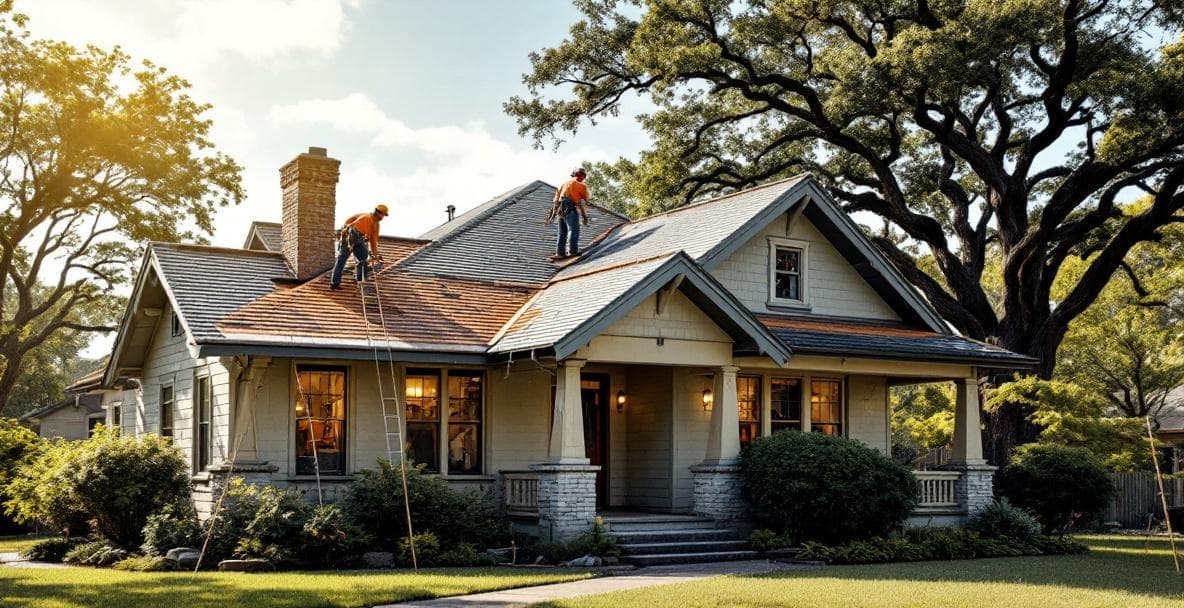
How to Hire a Roofer in Waco, TX (Without Getting Burned)
Waco homeowners face a roofing market that's genuinely more complicated than it looks. Texas doesn't license roofers. Spring hail storms roll through McLennan County on a near-annual basis. And every time a serious storm hits, out-of-state contractors descend on neighborhoods like Sanger Heights and Castle Heights before the gutters finish draining. If you've never hired a roofer before — or you hired one years ago and got lucky — this guide gives you the real framework for doing it right, from the first bid to the final inspection.
Why Waco Roofs Take a Harder Hit Than Most
Waco sits directly in a documented severe weather corridor. McLennan County appears with regularity on Texas Department of Insurance hail-loss maps during spring storm season, and that's not a marketing claim — it's the kind of actuarial fact that shapes what insurers charge homeowners in the 76700s. From March through June, supercell thunderstorms track along the I-35 corridor and drop hail that can strip granules from a five-year-old roof and crack the surface of an older one.
Summer doesn't offer much relief. Waco regularly records temperatures above 100°F, and sustained heat at that level accelerates granule loss and shingle brittleness on standard asphalt roofs faster than what manufacturers model for cooler climates. A 30-year shingle installed in central Texas may realistically perform for fewer years than the same product installed in the Pacific Northwest — material grade and installation quality matter more here because the conditions are harder.
Winter adds a third stress point. Ice storms hit Waco infrequently but hard, and aging housing stock in neighborhoods like Sanger Heights and Gorman carries older roof decking, original flashing, and gutters that weren't designed to flex through freeze-thaw cycles. Wind uplift from tornado-warned events rounds out the picture: four distinct damage vectors across twelve months.
The Magnolia and HGTV renovation wave has increased demand for quality work on older craftsman bungalows throughout Waco's historic neighborhoods. That's brought more contractors into the market — including more opportunists who know a motivated homeowner when they see one.
Texas Has No Roofing License — Here's What to Check Instead
This is the fact that surprises most Waco homeowners: Texas does not issue a statewide roofing contractor license. Anyone can legally pick up a hammer, print business cards, and call themselves a roofer in this state. There is no license board to check, no state credential to verify. That shifts all vetting responsibility directly to you.
Waco and McLennan County do require a general contractor registration for permitted work, which is the closest thing to a local credential backstop available. Ask any prospective roofer for their registration number and verify it before signing anything.
Beyond registration, here's what to request:
General liability insurance. A minimum of $1 million per occurrence is a reasonable consumer benchmark. Ask for a certificate of insurance naming you as certificate holder — this gives you direct notification if the policy lapses.
Workers' compensation coverage. Texas doesn't require private employers to carry workers' comp. That means if a worker is injured on your roof without it, they may have legal recourse against your property. Ask directly whether the contractor carries it.
Manufacturer certifications. Programs like GAF Master Elite and Owens Corning Preferred Contractor are voluntary, but earning them requires passing third-party audits on installation standards. A contractor who has maintained certification for multiple years has been vetted in a way that state law doesn't require.
Business history verification. Check the Texas Secretary of State business search and the BBB profile. Look at how long the company has been registered as a legal entity — not just how long the salesperson claims the company has been around. A long verbal claim and a two-year-old LLC registration tell you something.
Because Louisiana and Oklahoma operate roofing license boards and Texas doesn't, Waco homeowners genuinely carry more individual responsibility for vetting than residents of neighboring states. Local registration is the only formal backstop.
What Waco Permits Actually Cover (And Why You Need One)
Roofing projects in Waco that exceed $2,500 in value typically require a city building permit and a subsequent inspection. That threshold captures most full replacements and a significant number of mid-sized repair jobs — don't assume that because the work isn't a full tear-off, a permit isn't required. Confirm the scope of your specific project against that threshold before any work begins.
A permit does something that a contractor's word cannot: it puts a city inspector on-site to verify that the installation meets code. Without that inspection, you have no independent confirmation that the work was done correctly. You have the contractor's assurance, and nothing else.
Skipping a permit creates downstream problems that homeowners don't always anticipate. Unpermitted improvements surface during title searches and home inspections when you go to sell. Some insurance carriers will deny or reduce storm-damage claims if subsequent work on the roof was performed without required permits — get a straight answer from your insurer about this before work begins, in writing if possible.
A reputable contractor will pull the permit themselves and include it in the project scope as a line item. If a contractor asks you to pull the permit, suggests skipping it to save money, or goes quiet when you ask about it, treat that as a meaningful warning sign. Ask to see the permit posted at your property before work starts — it's a public document and confirms the contractor submitted accurate job information to the city.
Storm Chasers Target Waco Every Spring — Know the Warning Signs
After any significant hail event, neighborhoods across McLennan County see an influx of out-of-state and transient contractors knocking on doors within days. Many of these contractors are legitimate operations following the work. Many are not — and the ones who aren't are skilled at appearing trustworthy under time pressure.
Texas law gives you a specific protection here. Under Texas Property Code Chapter 27, you have the right to cancel a storm-related roofing contract within three business days of signing. This is a statutory right, not something a contractor can contract around. Most homeowners who get burned by storm chasers didn't know this right existed before they signed.
Texas law also prohibits contractors from requiring you to sign over your insurance claim or acting as your public adjuster unless they hold a Texas Department of Insurance adjuster license. Contractors who push an Assignment of Benefits or a similar arrangement without that license are violating state law — not bending the rules, violating them.
Recognize the pressure scripts. "This price is only good today" and "I have leftover materials from a job down the street" are classic storm-chaser lines. Reputable local contractors with established Waco operations don't run their business on manufactured urgency.
Before any insurance-related roofing work, call your insurer's claims line directly and report the damage yourself. Never let a contractor be the first contact with your insurance company on your behalf. Once a contractor is inserted into that relationship early, unraveling it is complicated.
To separate legitimate contractors from transient ones, ask for a permanent local business address (a PO box is not sufficient), a local phone number that has been active for more than a few months, and references from Waco-area jobs completed at least twelve months ago — long enough for any warranty issues to have surfaced.
Getting Multiple Bids in Waco: What to Compare and What to Ignore
Get at least three written, itemized bids. A contractor who will only provide a verbal estimate or a single lump-sum number is either unable or unwilling to specify what they're actually selling you. Move on.
The number that matters least in a bid comparison is the total. The numbers that matter are the material specifications, and Waco's climate makes those specifications unusually consequential.
Shingle grade and warranty tier. A 30-year architectural shingle and a standard 3-tab shingle are not equivalent products, and bids using different shingles are not comparable even at identical square footage. Ask each bidder for the shingle brand, product line, and warranty tier.
Underlayment type. In a market that sees 100°F-plus summers regularly, synthetic underlayment significantly outperforms traditional felt in longevity and moisture resistance. It should be standard in any Waco bid. If a bid specs felt underlayment to cut cost, that's a corner being cut in a market where it matters.
Full tear-off vs. overlay. In Texas heat, installing new shingles over existing layers compounds UV degradation, traps heat, and voids most manufacturer warranties. Verify that each bid includes complete removal of existing layers.
Decking contingency rate. Once tear-off begins, damaged decking sometimes surfaces. Get a per-sheet replacement rate in writing before work starts so there's no negotiating from a position of weakness mid-project.
When bids come in at significantly different totals, the lowest number is usually low for a reason. Compare line by line, not total to total, and ask each contractor to explain specifically what's different about their approach.
Navigating a Hail Damage Insurance Claim in McLennan County
McLennan County's recurring presence in Texas hail-loss corridors means local insurers and established Waco contractors both have real experience with the claims process — which is useful context when you're evaluating who you want in your corner.
Start by documenting damage yourself before anyone else is involved. Date-stamped photos from the ground, photos of granule accumulation in gutters and downspout splash blocks, and any visible shingle cracking or bruising are valid claim evidence. Do this within days of the storm, not weeks.
File promptly. Texas law gives insurers specific response deadlines: 15 days to acknowledge a claim and 15 business days to accept or reject after receiving proof of loss. Delays from the homeowner can complicate these timelines and give a carrier cover for slow processing.
Your insurer sends their own adjuster to assess damage. You are entitled to disagree with that estimate and request a re-inspection or hire a licensed public adjuster — you do not need a contractor to negotiate on your behalf, and a contractor who insists they need to handle your claim is overstepping their role.
The single most important line in your insurance policy is Actual Cash Value versus Replacement Cost Value. An ACV policy deducts depreciation from the claim payment, meaning the insurer's check may cover only a fraction of what replacement actually costs. Know which policy you have before you file.
Supplement claims — when a contractor's estimate exceeds the initial adjuster estimate — are common and legitimate. Experienced Texas insurance roofing contractors know how to document additional scope and submit supplements properly. Ask a prospective contractor specifically how many local insurance claims jobs they've completed in the past 24 months.
Before signing any document a contractor presents in connection with your insurance claim, understand exactly what authority you are transferring. Assignment of Benefits and Direction to Pay documents carry real legal weight.
Red Flags, Green Flags, and Questions to Ask Before You Sign
This section is the fast version of everything above. Run through it before any contractor conversation.
Green flags:
- Contractor volunteers proof of city registration, liability insurance certificate, and local references before you ask.
- Written contract includes detailed scope of work, material specifications, start and completion dates, payment schedule tied to milestones, and warranty terms.
- Contractor pulls the permit and includes it in the project scope without prompting.
Red flags:
- Request for full payment or a deposit exceeding 10-15% before work begins.
- No verifiable physical presence in the Waco area, no checkable history of McLennan County work, resistance to providing local references.
- Pressure to sign anything the same day as a door-knock, especially in the days following a storm.
- Vague or missing material specifications in a bid — shingle brand unspecified, underlayment type unlisted.
Ask these questions directly:
- "Will you pull the city permit?"
- "Who is the crew doing the work — your direct employees or a subcontractor?" Subcontracting isn't automatically a problem, but you deserve to know who is on your roof and whether they carry the same insurance.
- "Can you give me references from jobs in Sanger Heights, Castle Heights, or other historic Waco neighborhoods?" Older craftsman-style homes have aging decking, original flashing configurations, and non-standard roof pitches. Experience on newer suburban construction in Hewitt or Woodway doesn't automatically translate.
What a Quality Waco Roofing Contract Must Include
A contract that protects you contains specific, verifiable information — not just a price and a signature line. Before any money changes hands, confirm the following are in writing:
Contractor identity. Full legal business name, physical business address, general contractor registration number, and proof of insurance — not just the salesperson's name on a letterhead.
Material specifications. Shingle brand, product line, color, weight classification, and warranty tier. Underlayment type (synthetic or felt, specified by product if possible). Ice-and-water shield specification if applicable to your roof configuration.
Scope of work. Full tear-off versus overlay, number of existing layers to be removed, decking inspection protocol, and explicit statement of whether flashing is being replaced or reused. Reused flashing on an aging roof is a common cost-cut with real long-term consequences.
Payment schedule. Tied to project milestones, not arbitrary calendar dates. A reasonable structure: deposit at project start, progress payment at tear-off completion, final payment after city inspection passes.
Warranty terms. The manufacturer's product warranty, the manufacturer's workmanship warranty if the contractor is certified under that program, and the contractor's own labor warranty with an explicit duration. These are three separate documents and three separate protections.
Cancellation and dispute language. For storm-damage contracts, Texas Property Code Chapter 27 mandates specific disclosures and the three-business-day cancellation right. A contractor who omits this language is either unaware of state law or hoping you are. Either way, it tells you something.
Frequently Asked Questions
Do roofers in Waco Texas need a license?
No. Texas does not issue a statewide roofing contractor license, which means anyone can legally call themselves a roofer without any state-level vetting. Waco and McLennan County require a general contractor registration for permitted work, which is the closest local credential available. All other vetting — insurance, references, business history — falls to the homeowner.
How much does a roof replacement cost in Waco TX?
For a standard single-family home in Waco, full roof replacement using architectural shingles typically runs between $8,000 and $18,000 depending on square footage, pitch, material grade, and whether decking replacement is needed. Insurance-covered replacements may net out lower depending on your policy's Replacement Cost Value coverage and deductible. Get at least three itemized bids before accepting any number.
Does Waco require a permit for roof replacement?
Yes. Roofing projects in Waco that exceed $2,500 in value generally require a city building permit and a subsequent inspection. Most full replacements and many significant repair jobs cross that threshold. A reputable contractor will pull the permit as part of the project scope — if yours won't, that's a red flag.
What should I do after hail damage to my roof in Waco?
Document everything yourself first: date-stamped photos of visible damage from the ground, granule accumulation in gutters, and any cracked or bruised shingles you can safely see. Then call your insurance company directly to open a claim — before contacting any contractor. Prompt filing protects your rights under Texas insurer response deadlines.
How do I spot a storm chaser roofer in Waco?
Key signs include door-to-door solicitation within days of a storm, pressure to sign the same day, no verifiable local business address, and requests to sign over your insurance claim. Ask for a permanent Waco-area address, a local phone number, and references from jobs completed at least a year ago. Legitimate local contractors don't operate on manufactured urgency.
Can a roofing contractor negotiate my insurance claim in Texas?
Not without a Texas Department of Insurance adjuster license. A contractor can document damage and submit supplement claims based on their scope of work, but acting as your public adjuster — negotiating the claim on your behalf — requires a separate license. Contractors who push Assignment of Benefits arrangements without that credential are violating state law.
How long does a roof last in Central Texas heat?
A standard 30-year architectural shingle roof in Waco's climate realistically performs for 20 to 25 years under good installation conditions — the sustained 100°F-plus summer temperatures accelerate granule loss and shingle brittleness compared to cooler markets. Material grade, underlayment quality, and attic ventilation all affect actual lifespan. Premium shingles with stronger heat ratings perform meaningfully better here.
What is the 3-day cancellation rule for Texas roofing contracts?
Under Texas Property Code Chapter 27, homeowners have the right to cancel a storm-damage roofing contract within three business days of signing, without penalty. This right applies specifically to contracts solicited at your home following a weather event. The contractor is required to disclose this right in the contract — if yours doesn't include that language, the omission itself is a warning sign.
How do I find a reputable roofer in Sanger Heights or Castle Heights?
Ask for references from completed jobs specifically in those neighborhoods or comparable historic Waco areas. Older craftsman bungalows have non-standard roof pitches, original flashing, and aging decking that require different handling than newer suburban construction. Verify the contractor's McLennan County registration, check their BBB profile for complaint history, and confirm they've completed permitted work with city inspections — not just verbal claims of experience.