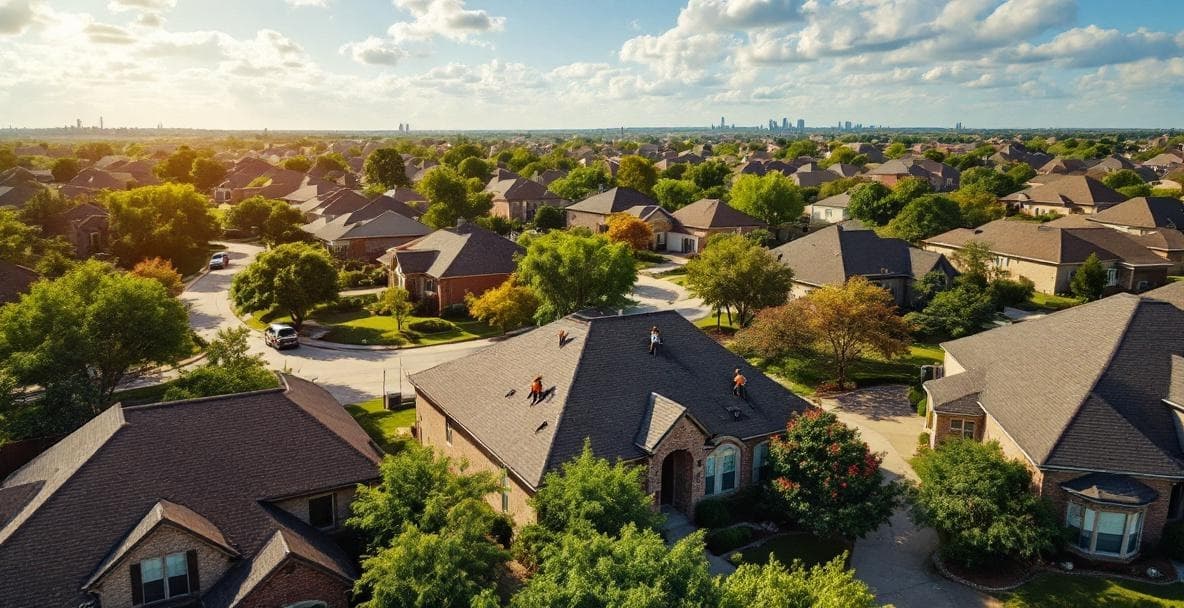
Roofing Contractor Advertising in Grand Prairie, TX: How to Win Jobs Before and After Every Storm
Grand Prairie sits squarely in North Texas Tornado Alley, and spring supercell storms don't announce themselves with much lead time. Hailstones exceeding one inch are routine from March through June — and within 48 hours of every major event, out-of-state storm chasers with six-figure ad budgets are already running calls in your service area. The contractors who win those jobs aren't necessarily better than you. They just had their advertising infrastructure in place before the storm hit.
This guide is written for Grand Prairie roofing owner-operators who want a practical, ROI-focused advertising playbook — one that accounts for local compliance requirements, neighborhood-level targeting, and the seasonal demand cycles that define this market.
Why Grand Prairie Is a High-Opportunity — and High-Competition — Roofing Market
The February 2021 Winter Storm Uri exposed a real divide among Grand Prairie contractors. The storm was primarily a freeze event — burst pipes rather than wind or hail — but the resulting insurance claims and interior water damage sent homeowners looking for roofers who could assess and document damage, tarp compromised areas, and manage the repair process. Owners who had active Google Business Profiles, a review history, and a basic website fielded calls throughout the event and the months that followed. Those who relied on word-of-mouth watched out-of-area operators absorb demand that belonged in their own backyard.
That gap wasn't about skill. It was about visibility.
Grand Prairie generates recurring roofing demand from multiple directions at once. Spring supercell storms track northeast along the DFW Metroplex corridor and routinely deposit 1-inch-plus hail across the city, creating predictable demand spikes that smart operators plan for. At the same time, the city's housing stock splits into two distinct revenue streams: 1970s–1990s brick-and-frame ranch homes in neighborhoods like Dalworth Park that are at or past their 25-year shingle lifespan, and newer master-planned communities like Grand Peninsula and the emerging Goodland development generating repair, warranty, and storm-response work.
Layered on top of that is fast population growth along Grand Prairie's southern corridor, where new homeowners arrive without existing contractor relationships and turn directly to Google when something goes wrong.
The window between a storm event and a signed contract is often 48–72 hours. Homeowners in Fish Creek or Grand Peninsula aren't waiting a week to compare estimates — they're calling whoever shows up first in search results. Contractors who build brand recognition before storm season don't just compete; they capture. Those who wait compete on price against chasers willing to absorb losses to break into the DFW market.
Know the Rules Before You Run an Ad: Grand Prairie Compliance Essentials
Texas SB 1567 has generated real enforcement attention across DFW, and storm-season ad copy is one of the most common places local contractors unknowingly step into legal exposure. Before you write a single ad, get clear on what you can and can't say.
Texas does not require a statewide roofing license, but Grand Prairie requires a City of Grand Prairie business registration. Running ads without one isn't just a fine risk — it's a credibility problem if a competitor or a skeptical homeowner reports you.
Building permits are required for new roofs and most full replacements through the Grand Prairie Building Inspections Division. Any ad copy implying you skip the permit process is both a liability and a red flag to property managers and informed homeowners who know better.
General liability and workers' compensation insurance are mandatory per city contractor requirements. "Fully insured" in your ad copy must be provably true — savvy homeowners and commercial property managers will ask for certificates before signing anything.
The SB 1567 trap is the one that catches the most out-of-area operators: Texas law prohibits roofing contractors from negotiating or settling insurance claims on behalf of property owners without a separate public adjuster license. Any language in your ads implying that you "handle the claim for them" creates genuine legal exposure. The compliant version is explaining what your inspection documents and what you provide to help the homeowner work with their own adjuster.
Grand Prairie also follows IBC and IRC codes as adopted by the city, including secondary water barrier requirements in certain applications. Advertising that you install to code — and knowing exactly what that means — is a differentiator against cut-rate competitors who don't.
Get your registration, insurance certificates, and permit process in order first. Then your advertising can make claims you can actually stand behind.
Build Your Digital Foundation: The Local Assets That Drive Inbound Calls
Grand Prairie homeowners searching after a hail event don't sit down at a desktop. They're on their phone in the driveway, searching "roofer near Joe Pool Lake" or "Grand Prairie roof repair" within hours of storm passage. A Google Business Profile without photos or recent reviews ranks behind competitors who've invested in those signals — and in a 48-hour decision window, ranking second is often the same as not ranking at all.
Five things need to be in place before you spend a dollar on paid advertising:
Google Business Profile. Set Grand Prairie as your primary service area, use a local phone number, and upload photos of completed jobs in recognizable neighborhoods — a finished roof on a Dalworth Park ranch home does more credibility work than a stock photo of shingles. Proximity signals matter in local pack rankings, and genuine local photos are one of them.
Service-area landing page. Your website needs a page targeting "Grand Prairie roofing" with neighborhood-specific references. Mentioning Fish Creek, the Carrier Parkway Corridor, or Lynn Creek tells both Google and your prospective customer that you actually work here, not just that you serve a 50-mile radius from somewhere else.
Review acquisition system. After every completed job, send a text or email with a direct link to your Google review page. Volume and recency of reviews are the single biggest trust signal in a post-storm search environment. Two to four new reviews per month during active season should be a tracked KPI, not an afterthought.
Mobile-first website speed. A homeowner searching from their driveway after a storm won't wait for a slow site to load. Under three seconds is the standard — above that, you lose the call before it starts.
NAP consistency. Your business name, address, and phone number need to match exactly across Google, Yelp, BBB, and any DFW contractor directories you're listed in. Inconsistencies suppress local search rankings in ways that take months to unwind.
This foundation isn't glamorous, but it's what determines whether your paid campaigns have any surface area to land on.
Storm Season Ad Strategy: Turning March–June Hail Events Into Booked Jobs
Grand Prairie's spring supercell storms often track northeast along the DFW Metroplex corridor. A system that drops 1.5-inch hail on Midlothian is frequently the same storm that hits Grand Prairie 45 minutes later. Contractors who monitor weather radar have a narrow window to pre-position ads — and those who don't are starting from zero when the phones should already be ringing.
Here's how to structure your paid advertising around that cycle:
Launch Google Search campaigns by late February. Bid on terms like "hail damage roof repair Grand Prairie," "roof replacement Grand Prairie TX," and insurance-adjacent searches. Run reduced spend during the off-season to protect budget, but have campaigns ready to scale immediately when storm reports start coming in.
Use geofencing display ads tied to real-time storm-track data. Services like HailTrace or StormAware provide parcel-level hail reports that let you target ads specifically to affected zip codes — Grand Peninsula, Fish Creek, or wherever the storm actually touched down — within 24 hours of impact. That specificity beats a broad DFW campaign on both relevance and cost-per-click.
Prepare storm-response ad copy variants in advance. "Storm hit Grand Prairie? Free hail damage inspection" should already be written, approved, and ready to activate. Campaigns that go live in hours outperform ones that take days to build from scratch.
Build a dedicated storm-response landing page. It should address insurance-claim concerns directly without crossing the SB 1567 line: explain what your inspection covers, what documentation you provide, and that the homeowner engages with their own adjuster. This page does the trust-building work your ad copy can only gesture at.
Track calls, not clicks. Install call tracking numbers in your ads so you know which campaigns are generating booked inspections versus website visits that go nowhere. A $15 click that books a $15,000 replacement is a better investment than a $3 click that generates a question about pricing.
Neighborhood-Level Targeting: Where to Concentrate Your Marketing Spend
Grand Prairie's housing age gradient runs roughly west to east — older ranch-home stock near Dalworth Park in the west, newer subdivisions pushing toward the Dallas County line in the east. Your budget allocation should reflect that geography based on which job type you're optimizing for.
Dalworth Park and the Carrier Parkway Corridor. This is your full-replacement market. 1970s–1990s housing stock means roofs at or past their 25-year asphalt shingle lifespan. Messaging here should lead with honest condition assessments and financing options — these homeowners often know replacement is coming but are waiting for someone to make the process manageable.
Westchester, Sheffield, and newer subdivisions near the Dallas County line. The pitch changes here. These homeowners want speed, code compliance, and manufacturer warranty preservation. Storm-response messaging works well; so does language about protecting a newer home's long-term value.
Lynn Creek and Grand Peninsula near Joe Pool Lake. Higher-income households respond to premium positioning. Metal roofing upsells, extended warranties, and financing options close better in this corridor than anywhere else in Grand Prairie. Don't lead with price — lead with quality and longevity. Grand Peninsula was built as a master-planned community starting in the early 2000s, meaning its roofs are now approaching or at replacement age, which makes it a strong organic-replacement market independent of storm cycles.
Use Google Ads zip-code or radius targeting to concentrate spend in neighborhoods where you've already completed jobs. A finished roof in a neighborhood creates review authority and word-of-mouth that multiplies your paid spend rather than working against it. Reinforce digital campaigns with door hangers and yard signs in those same neighborhoods — homeowners who see a crew on their street and then encounter your ad online convert at measurably higher rates.
Reputation and Trust Signals That Close Grand Prairie Homeowners
Grand Prairie's diverse, working-class and middle-income demographic makes price transparency and payment flexibility frequent deciding factors between two otherwise comparable contractors. Hiding your pricing model or refusing to itemize estimates costs you signed contracts — not just impressions.
Display your City of Grand Prairie business registration number and proof of insurance on your website and in your ad creative. Competitors who can't do this are disqualified in the minds of careful homeowners and property managers. Making that information easy to find tells prospects you have nothing to hide.
Use before-and-after photos from actual Grand Prairie neighborhoods, not stock images. A homeowner in Dalworth Park recognizes a ranch-style brick home like their own and trusts that you understand local architecture and code requirements. That recognition doesn't happen with generic roofing photography.
Testimonials that name a neighborhood or a specific storm event — "They fixed our roof in Fish Creek after the April hail storm in 48 hours" — outperform generic five-star reviews because they're falsifiable and specific. Specificity signals authenticity.
Nextdoor is a high-value, underused channel in Grand Prairie's suburban neighborhoods. In HOA-active areas like Grand Peninsula and Westchester, a single contractor recommendation thread can drive more qualified calls than a week of paid search spend. You can't buy that placement — you earn it through consistent work quality and a deliberate habit of asking satisfied customers to mention you by name when their neighbors ask for referrals. Monitor local neighborhood feeds after storm events; homeowners ask for contractor recommendations within hours of significant weather, and a timely, professional response to those threads carries real weight.
Offer written, itemized estimates. Grand Prairie homeowners managing insurance claims need documentation, and contractors who provide clear paperwork win over those who quote verbally. This isn't just a trust signal — it actively supports the homeowner's adjuster process without crossing the SB 1567 line.
Reference financing or payment plans in your ad copy. This expands your accessible market to the working-class and middle-income households that make up a significant share of Grand Prairie's residential base. A homeowner who knows payment flexibility is available will call you; one who assumes you require full payment upfront may not.
What Ignoring Local Advertising Actually Costs You
After Winter Storm Uri in February 2021, Grand Prairie experienced sustained demand for roofing inspections, emergency repairs, and insurance documentation work over several months. Contractors with established digital presence and review histories captured that demand as homeowners searched for help. Those without were passed over as homeowners defaulted to whoever ranked highest on Google — and that ranking advantage compounds over time through accumulated reviews and completed-job signals.
Out-of-state storm chasers with six-figure ad budgets descend on DFW after every major hail event. A Grand Prairie owner without a live campaign during a storm cycle is invisible while a non-local competitor takes calls in their own service area and collects yard signs in their own neighborhoods.
The math isn't abstract. A single missed storm cycle in a dense suburban market like Grand Prairie can represent dozens of jobs. Homeowners who couldn't find you within 72 hours of a storm didn't wait — they called whoever appeared first in search results, and that contractor now has the referrals, the yard signs, and the review authority in your neighborhood for years.
Relying on referrals without digital reinforcement creates a fragile pipeline. One slow season, one key referral source relocating, and revenue collapses with no digital floor to catch it. And every month without a review acquisition strategy is compounding lost local search authority — competitors who collect reviews consistently during slow periods dominate the local pack when storm season demand spikes.
Real Ad Frameworks for Texas Roofers — The Psychology Behind What Converts
The examples below are drawn from active roofing campaigns across the Texas market. None are from Grand Prairie specifically, but the conversion mechanics behind each one apply directly here — the same homeowner psychology drives decisions across DFW suburban markets. Study the structure, then build the same patterns into your own copy with Grand Prairie neighborhoods and storm events substituted in.
Fear Hook — Drive Urgency for Roof Repairs
Hook. The ad opens by naming a specific, stressful situation — roof damage — and immediately pairs it with a command to act fast. This is a classic named-fear hook: it bypasses general browsing mode and speaks directly to someone who already suspects or knows they have a problem, jolting them out of passive scrolling.
Angle. The angle is fear-based urgency, leaning on the idea that delay equals greater damage and greater cost. The tagline pairing quality with urgency addresses the two things a homeowner with roof damage fears most: getting ripped off on workmanship and waiting too long while water damage spreads.
Cognitive bias. Loss aversion is the dominant bias here — the brain weights potential losses, like structural water damage or a ruined interior, far more heavily than equivalent gains. By framing inaction as the risky choice, the ad nudges the viewer toward the conclusion that calling now is the safe, loss-minimizing move rather than a purchase decision.
Why it converts. A homeowner who has noticed a leak, missing shingles, or storm damage is already in an anxious mental state. This ad meets that anxiety with a permission structure: "act fast" is socially sanctioned urgency, not pushy sales language. That reduces friction because the viewer feels the ad is confirming what they already know they should do.
What to steal. Pair your fear hook with a specific consequence of delay rather than leaving the threat vague — something like water reaching the insulation or a small repair turning into a full replacement. Name a Grand Prairie neighborhood or a recent storm event in the headline to anchor the fear locally. Concrete downstream harm activates loss aversion far more powerfully than a generic "act fast" command.
Free Inspection — Turn Ambient Anxiety Into a Booked Call
Hook. The opening frames roof maintenance as an ongoing vulnerability rather than a one-time event, using present-tense language to imply constant exposure to risk. It then pivots to urgency by warning the reader not to wait for visible damage — positioning inaction as the dangerous choice. This works because it meets the homeowner at a moment of ambient worry they already carry but rarely act on.
Angle. This is a fear angle built around anticipated regret — the idea that doing nothing today guarantees a worse outcome tomorrow. The ad doesn't sell roofing services so much as it sells the relief of having checked, turning a free inspection into an emotional insurance policy. A subhead like "Catch Roof Problems Early" reinforces this by making the homeowner feel like a responsible actor rather than a passive victim.
Cognitive bias. Loss aversion, specifically activated through present-tense loss framing — the hook implies damage may already be forming unseen, making inaction feel like an active choice to lose. The zero-cost inspection offer removes the financial friction that would otherwise block the next step, making the psychological cost of not acting higher than the cost of acting.
Why it converts. The ad puts the reader into a state of low-grade anxiety about something they cannot see and therefore cannot easily dismiss — unseen roof damage is the perfect fear object because it cannot be falsified without an expert. That anxious state creates a desire for resolution, and the free inspection is the lowest-friction path to that resolution.
What to steal. Use present-tense loss language in your headline — "may already be forming" converts better than "could happen someday." Pair it with a zero-cost entry offer to eliminate the financial objection. In Grand Prairie, timing this ad to run in the weeks following any documented hail event maximizes relevance for the largest number of homeowners who haven't yet acted on their concern.
Veteran- or Family-Owned Identity — Build Trust Before Price Comes Up
Hook. The ad opens by reframing what a roof actually is — not a commodity product but an act of protection and care for something the homeowner values. This elevates the emotional stakes before any service details are mentioned, pulling the viewer out of comparison-shopping mode.
Angle. The ad runs a story angle built around identity: veteran-owned and family-run are not just credentials, they are character signals meant to tell the viewer what kind of people will be standing on their roof. A tagline like "protecting what you've built" ties the emotional positioning together into a single image that competitors selling on price cannot easily copy.
Cognitive bias. In-group identity and authority bias work together here. Veteran-owned status triggers a well-documented trust heuristic — many consumers extend automatic credibility to veteran-run businesses as a proxy for discipline, reliability, and integrity. Family-run reinforces this by activating the signal that the people doing the work have skin in the game.
Why it converts. Roofing is a high-anxiety, infrequent purchase where the average consumer has almost no ability to evaluate technical quality, so they default to trusting the people instead of the product. An ad that successfully signals trustworthy people short-circuits the anxiety loop and moves the prospect toward inquiry with far less friction than a specs-and-price ad.
What to steal. If your business has any authentic identity credential — veteran-owned, family-run, locally rooted, licensed for decades — lead with it before you say a single word about services or pricing. In Grand Prairie specifically, pairing that identity credential with your City registration number and local job photos turns a character claim into a verifiable one, which matters in a market where homeowners have been burned by out-of-state chasers before.
The Neighborhood Direct Mail Play — Turn Completed Jobs Into New Leads
Hook. A postcard addressed to a specific ZIP code — Dalworth Park, Fish Creek, Grand Peninsula — that references the neighborhood by name, mentions a recent weather event, and includes a before/after photo of an actual Grand Prairie job nearby.
Angle. This is a social proof and local authority play. The implied message is: someone on your street or in your neighborhood already trusted us, and you can verify it. In a market saturated with storm chasers making identical claims, evidence of local work is a genuine differentiator.
Why it converts. Seeing that a neighbor used you compresses the evaluation phase dramatically. The homeowner doesn't need to research you as heavily because someone nearby already did. Grand Prairie's older, established neighborhoods like Dalworth Park and the Carrier Parkway Corridor have the density and tenure to make neighborhood-level direct mail highly efficient.
What to steal. Map your completed jobs by ZIP code and build a post-job direct mail sequence targeting a one-mile radius around each completed project. Time the send within 30 days of job completion, ideally following any recent weather event. Include the approximate job location (with customer permission), a photo, and a specific call to action. On a cost-per-lead basis, this approach frequently outperforms broad metro digital spend for these neighborhood types.
Measuring What Works: The Metrics Grand Prairie Roofing Owners Should Track
Most Grand Prairie contractors can tell you roughly how much they spent on ads last month. Very few can tell you the cost per booked inspection — and that gap is where budget gets wasted.
Track cost-per-booked-inspection, not cost-per-click. A $15 click that converts to a $15,000 replacement job is a fundamentally different investment than a $3 click that generates a tire-kicker call. Without that distinction in your reporting, you can't make rational decisions about where to put next month's budget.
Attribute every inbound call to a source — Google ad, organic search, referral, yard sign — using dedicated call tracking numbers for each channel. Contractors who can't identify where their calls originate are making budget decisions based on guesswork.
Check your Google Business Profile insights monthly. How many searches triggered your listing? How many drove calls versus direction requests? Direction requests broken down by zip code tell you which neighborhoods are actually responding to your presence — that data should inform your radius targeting and door-hanger runs.
Set a monthly review count target and treat it as a KPI alongside revenue. Review velocity directly impacts local pack ranking, and the contractors who collect two to four reviews per month during slow periods are the ones who dominate the pack when storm season demand explodes.
After each storm event, run a post-campaign analysis: inspections booked, conversion rate to signed contracts, average job value. That analysis tells you whether to increase storm-season ad spend next cycle or reallocate toward reputation-building during the off-season. Over two or three storm seasons, this data compounds into a real competitive advantage — you'll know exactly what a Grand Prairie hail event is worth to your business before the first stone falls.
FAQ
Do I need a license to do roofing work in Grand Prairie, Texas?
Texas does not have a statewide roofing contractor license requirement. However, you must hold a City of Grand Prairie business registration to operate legally within city limits. Operating without it exposes you to fines and creates a credibility problem if a competitor or customer reports the gap.
What permits are required for roof replacement in Grand Prairie TX?
A building permit is required for new roofs and most full replacements, issued through the Grand Prairie Building Inspections Division. Repair work may or may not require a permit depending on scope — contact the Building Inspections Division directly to confirm requirements for your specific project type before pulling ads that make any permit-related claims.
How do I get roofing leads after a hail storm in Grand Prairie?
The fastest path is a live Google Search campaign targeting hail damage terms in Grand Prairie zip codes, paired with geofencing display ads served to neighborhoods confirmed by hail-tracking services like HailTrace. Both require existing campaign infrastructure — contractors who build their ad accounts before storm season activate in hours; those starting from scratch after a storm miss the critical 48-72 hour window when most homeowners make their first call. Also monitor Nextdoor neighborhood feeds immediately after any storm event — homeowners post contractor requests within hours of significant weather, and a prompt, professional response there can generate calls faster than any paid channel.
Can a roofing contractor in Texas handle my insurance claim for me?
No. Texas SB 1567 prohibits roofing contractors from negotiating or settling insurance claims on behalf of property owners without a separate public adjuster license. What a licensed roofing contractor can do is conduct a thorough inspection, document damage, and provide detailed reports that help the homeowner work with their own adjuster. Any contractor or ad promising to "handle your claim" without a public adjuster license is operating outside the law.
How much does it cost to advertise a roofing company in DFW?
Google Search cost-per-click for roofing terms in DFW has historically ranged from roughly $15–$45 depending on keyword competitiveness and time of year, with costs spiking immediately after major storm events when out-of-state chasers flood the auction — though specific rates shift with market conditions and should be verified against current campaign data before budgeting. A realistic monthly budget for a Grand Prairie contractor targeting storm-season leads is $2,000–$5,000 in paid search, with additional spend on geofencing display and local SEO infrastructure. The right number depends on your target job volume and average ticket — work backward from cost-per-booked-inspection, not cost-per-click.
How do I compete with out-of-state storm chasers in Grand Prairie?
Your structural advantages are local presence, compliance documentation, and review history — none of which storm chasers can fake quickly. Lead every ad with your City of Grand Prairie registration, insurance certificates, and genuine neighborhood-specific reviews. Storm chasers win on ad budget; you win on trust signals and local search authority built over time. Homeowners who do any due diligence at all will choose the contractor with a local presence, real reviews, and verifiable credentials over an unfamiliar out-of-state name.
What insurance does a roofing contractor need in Grand Prairie TX?
City of Grand Prairie contractor requirements mandate general liability insurance and workers' compensation insurance. Your liability coverage should be sufficient to cover the replacement value of the homes you work on — most commercial property managers and informed homeowners expect at least $1 million in general liability coverage. Always carry current certificates of insurance and be prepared to provide them before work begins; advertising "fully insured" without documentation to back it up is both a credibility risk and a potential legal problem.
How do I rank my roofing company on Google in Grand Prairie?
Local pack ranking is driven primarily by Google Business Profile completeness, review volume and recency, and proximity signals. Start with a fully built-out profile using a local phone number and photos of actual Grand Prairie jobs. Build a service-area landing page on your website with genuine neighborhood references. Then run a consistent review acquisition process after every job. NAP consistency across all directories removes suppression factors. This compounds slowly — contractors who start six months before storm season are significantly better positioned than those who start the week a storm hits.