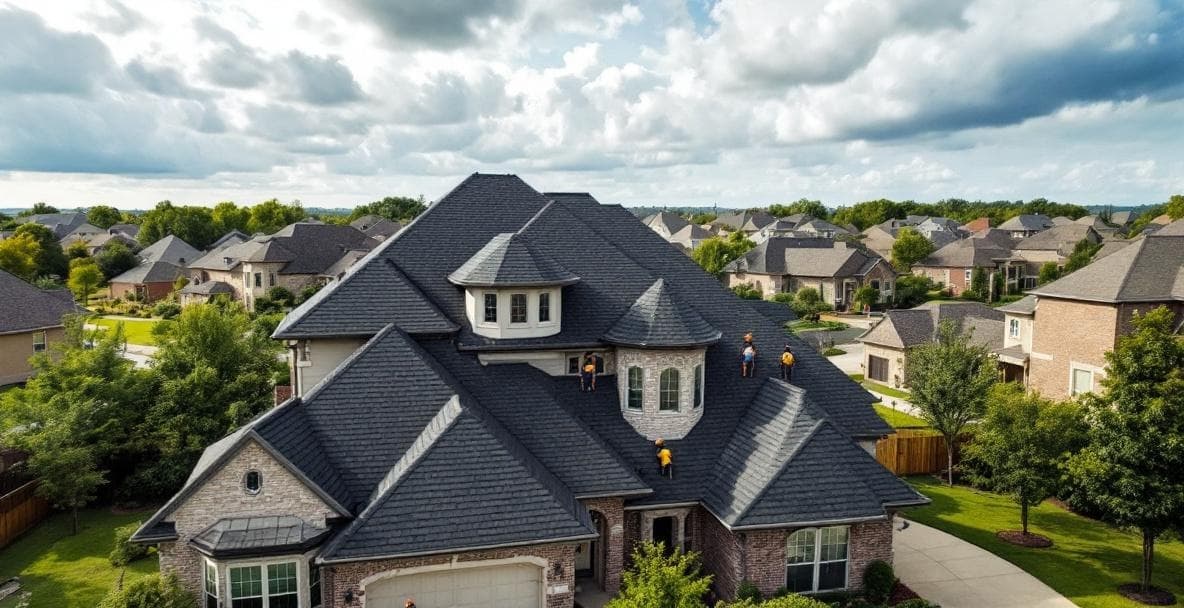
Roofing Contractor Advertising in McKinney, TX: How to Own Hail Season and Win Premium Jobs
McKinney's population crossed 220,000 by 2024, and nearly all of that growth is owner-occupied housing — not rentals. For a roofing contractor, that distinction matters more than the headline number. Renters don't authorize $15,000 roof replacements. Homeowners in Craig Ranch and Stonebridge Ranch do, and they're signing those contracts every spring when Collin County supercells come through. This guide covers exactly how to put your company in front of them before, during, and after those storms — and how to build the brand infrastructure that keeps out-of-state storm chasers from eating your lunch.
Why McKinney Is One of DFW's Strongest Roofing Markets Right Now
McKinney has ranked among the fastest-growing U.S. cities for over a decade. That growth rate translates directly into a deep replacement pipeline — new roofs installed during construction booms age together, creating concentrated replacement demand as those homes hit the 15- to 20-year mark. You're already in that window on older subdivisions, and the newer builds are not far behind.
The master-planned community structure here is unusual and valuable. Craig Ranch, Stonebridge Ranch, Tucker Hill, and Adriatica Village aren't just neighborhoods — they're concentrations of upper-middle-income homeowners who expect premium products and have the financial capacity to pay for them. Class 4 impact-resistant upgrades, full decking replacements, premium architectural shingles: these are normal conversations in these ZIP codes, not upsells you have to fight for.
Collin County also sits squarely in North Texas's most hail-active corridor. Spring storm seasons routinely generate multi-thousand-home replacement cycles within weeks. The catch: every major hail event draws out-of-state storm chasers. They load their trucks and hit I-35 within 48 hours of a confirmed event. Year-round brand presence — reviews, local search visibility, neighborhood reputation — is the primary thing that separates a McKinney-based operator from those transient competitors. The work is here. The question is whether homeowners already know your name when they go looking.
Map Your Storm Calendar to Your Ad Spend
Running flat ad spend year-round in McKinney is a budget inefficiency. The market has a rhythm, and your spend should match it.
March through June is peak hail season in Collin County. NOAA storm track data confirms that the most damaging supercell events in this area predominantly run from the southwest during this window. Budget 40 to 50 percent of your annual advertising spend here. This is your harvest period.
January and February are your setup months. Pre-season brand building — consistent Google search visibility, GBP optimization, review accumulation — means your name is already familiar when the first spring storm hits. Paid search CPCs are measurably lower before storm season activates, so this is also the window to build your remarketing audiences cheaply.
Post-storm response requires speed. When a confirmed hail event hits Stonebridge Ranch or Eldorado, your canvassing teams should be rolling within 24 to 48 hours and your digital campaigns should be shifted to flood budget into neighborhood-specific keywords the same day. Pair door-knocking with retargeting ads served to users in the affected ZIP codes — that dual-channel presence dramatically outperforms either tactic alone.
Summer messaging should pivot away from storm damage entirely. South- and west-facing slopes in 100°F-plus McKinney heat age measurably faster than north-facing surfaces. Position maintenance inspections and thermal degradation assessments as your summer offer — it keeps the phone ringing and positions you as an expert, not just a storm chaser.
Q4 and Q1 aren't dead. North Texas doesn't get snowpack, but freezing rain events create real gutter and flashing damage. A winter service campaign targeting your existing customer base generates word-of-mouth, keeps crews productive, and produces the kind of recurring relationship that turns a one-time job into lifetime customer value.
Own Local Search Before the Next Storm Hits
Searches for "hail damage roof McKinney" spike within hours of a Collin County storm event. If your Google Business Profile isn't optimized and review-loaded before that storm, you lose those leads permanently. There is no catching up after the surge; homeowners make decisions fast in post-storm urgency.
Start with your GBP. McKinney must be your primary service area, but also explicitly add Craig Ranch, Stonebridge Ranch, Adriatica Village, Tucker Hill, and Eldorado in your service area settings. The high-value residential ZIPs to anchor your visibility are 75070 (Craig Ranch's primary ZIP), 75071, and 75072 (which covers the core of Stonebridge Ranch). Stonebridge Ranch spans multiple ZIP codes — 75072 is the largest concentration, but homes in the community also fall in 75070 and 75071 — so target all three rather than treating any single ZIP as a complete proxy for the neighborhood.
Build individual landing pages for your highest-value communities. A page titled "Roofing Contractor in Stonebridge Ranch, McKinney TX" that speaks to that community's specific housing stock and homeowner profile will outrank a generic McKinney city page for high-intent local searches. These pages take time to build authority, which is another reason to do this work before storm season, not during it.
Reviews are not optional. Fifty or more Google reviews with photo documentation of local jobs is a reasonable baseline threshold to compete in the Local Pack for "McKinney roofer" queries. Build a post-job review request into your workflow now — a direct text with a review link sent the day final inspection passes will generate reviews at 3 to 5 times the rate of a generic follow-up email sent a week later.
Citation consistency across Angi, HomeAdvisor, BBB, and Collin County-specific directories matters for ranking. NAP inconsistencies — name, address, phone number varying across platforms — erode local authority. Audit these annually.
For keyword targeting, long-tail terms like "hail damage roof repair McKinney TX" and "Class 4 shingle installer Collin County" convert at significantly higher rates than broad "roofer near me" terms. The search volume is lower, but the intent is far more specific and the close rates reflect it.
Paid Advertising That Actually Converts in This Market
Collin County has a well-documented history of significant hail events — the March 2019 storm alone generated an estimated $300–$400 million in insured damage across Allen, McKinney, and Frisco, according to the Insurance Council of Texas, with baseball-sized hail reported in corridors between Frisco and McKinney. More recent events in April 2021 produced 1.5- to 2-inch hail near the area. The pattern is consistent: Collin County gets hit, homeowners flood search in the 48 hours that follow, and contractors with live paid infrastructure capture the demand while those scrambling to set up campaigns miss the window.
Google Local Services Ads are non-negotiable in this market. The "Google Guaranteed" badge functions as a trust signal for Collin County homeowners who are filing insurance claims and vetting multiple contractors simultaneously. They're moving fast and they're risk-averse — that badge shortens the trust-building process in a way no other ad format does.
Run always-on branded search campaigns. Storm chasers in post-hail DFW markets routinely buy local competitors' company names as keywords — this is a documented tactic. A branded campaign that costs you next to nothing in normal conditions protects your name when it matters most.
Keep your location radius tight. Broad DFW targeting burns budget on leads outside your profitable service zone. McKinney jobs in 75070, 75071, and 75072 should anchor your bid geography, with Collin County as the outer boundary. A lead from Plano or Frisco might be fine; a lead from Fort Worth almost certainly isn't worth your drive cost.
Facebook and Instagram retargeting work unusually well in McKinney's master-planned communities. These neighborhoods have dense social networks — neighbors talk to neighbors, HOA community boards circulate, Facebook groups are active. A single job photographed well and shared in a targeted retargeting campaign can generate three to five organic referral inquiries. The social proof is hyper-local, which makes it disproportionately credible.
Post-storm paid strategy is a distinct mode: pause broad awareness spend and shift budget aggressively into "hail damage roof repair [neighborhood name]" exact and phrase match terms within hours of a confirmed event. CPCs will spike — expect it. Conversion rates spike harder, and the lead quality during that window is among the highest of the entire year.
Ad Frameworks That Work for McKinney Homeowners — And Why
The structures below analyze approaches specifically relevant to advertising roofing services to McKinney homeowners. These aren't breakdowns of ads running in your market verbatim — they're descriptions of conversion mechanics that apply directly to this audience. Study the structure, then build these patterns into your own campaigns with neighborhood names and local storm events substituted in.
The Named-Fear Hook With a Concrete Consequence
What it looks like. "Hail hit Stonebridge Ranch last week. Here's what your neighbor didn't know to look for." The ad opens by naming a specific, local anxiety — storm damage the homeowner may have — and immediately pairs it with a reason that urgency is justified: there's damage they can't see from the ground.
Why it works in McKinney. Homeowners in Craig Ranch and Stonebridge Ranch are not naive about hail; they've lived through multiple Collin County events. An ad that treats them as knowledgeable rather than alarming them generically earns more credibility. Framing the damage as potentially invisible — not just visually obvious — is both accurate and more compelling, because it makes action feel responsible rather than reactive.
The mechanism. Loss aversion drives the response. The brain treats a potential undetected problem as an ongoing risk, which creates a low-grade discomfort that the free inspection offer relieves. The homeowner isn't deciding whether to hire you — they're deciding whether to remove uncertainty for free. That's a much easier conversion.
What to steal. Name the specific storm event or date in your headline when possible. Follow with a one-sentence explanation of why invisible damage matters — water can reach the decking before it appears on the ceiling — and close with a zero-friction offer. The named-fear hook structure converts because it meets the homeowner where they already are, rather than manufacturing anxiety about something they weren't thinking about.
The Credentials-First Approach for HOA Communities
What it looks like. "GAF Master Elite Certified · $1M General Liability · Every Job Permitted · Serving Craig Ranch Since 2011." The ad leads entirely with verification before making any service claim.
Why it works in McKinney. After every major Collin County hail event, storm chasers are visible on every block in Stonebridge Ranch and Craig Ranch within days. These homeowners have heard the pitch. By the time a storm-season ad reaches them, they're not evaluating services — they're filtering for legitimacy. An ad that leads with credentials acknowledges that filtering process directly and passes the screen before asking for a click.
The mechanism. The credentials do two things at once. Manufacturer certifications like GAF Master Elite act as third-party endorsements, transferring trust without the contractor having to claim it. Local tenure — "serving Craig Ranch since [year]" — counters the storm-chaser perception before it forms. Together, they answer the homeowner's first question ("Are these people legitimate?") before the second one ("What do they charge?") ever gets asked.
What to steal. In HOA markets, lead with your most verifiable credential in the headline. Don't bury GAF certification in the third line of body copy. Pair it with a specific local tenure claim, a permit-compliance signal, and a reference to a named McKinney community. In Stonebridge Ranch especially, where HOA enforcement is active and homeowners are accustomed to vetting contractors carefully, the credentials-first approach converts better than any urgency or price-based angle.
The Identity Frame — Local Roots as a Competitive Advantage
What it looks like. "Veteran-owned, McKinney-rooted. We're here when the storm chasers aren't." The ad leads with a character credential and pairs it immediately with the thing homeowners in storm-prone markets fear most: hiring someone who disappears after the job.
Why it works in McKinney. The fear of being left with a botched roof and no warranty recourse is real in Collin County, where out-of-state operators flood the market after every event. An ad that names this dynamic and positions against it — by signaling permanence and accountability through identity — does something purely feature-based ads can't: it changes the emotional frame from "who's cheapest?" to "who can I trust?"
The mechanism. Any authentic identity credential — veteran-owned, family-run, locally founded, licensed in McKinney for a decade — works as a trust shortcut in a category where homeowners have no reliable way to evaluate technical quality from an ad. They default to judging the people. An ad that gives them a clear reason to prefer you on character grounds reduces the friction between first impression and phone call.
What to steal. If your business has a genuine identity credential, lead with it before services or pricing. Then attach it to the specific outcome McKinney homeowners are buying when they hire a local roofer rather than a chaser: they're buying accountability after the job is finished. Make that connection explicit in your copy and the credential stops being a boast and becomes a promise.
The Free Inspection Sequence — Turn Ambient Worry Into a Booked Call
What it looks like. "Your roof survived the storm. But here's what you can't see from the driveway." Followed by a brief explanation of how hail damage is often invisible at street level but significant at the shingle surface, ending with a free inspection offer.
Why it works in McKinney. A large portion of homeowners after a Collin County storm assume their roof is fine because they don't see obvious damage. This ad creates salience around something they genuinely can't evaluate themselves, and immediately offers a costless way to resolve the uncertainty. The free inspection isn't a sales tactic to them — it's a rational next step.
The mechanism. The ad manufactures low-grade concern about a problem the homeowner couldn't otherwise falsify, then hands them an effortless resolution. Because the offer is free and the ask is just an inspection — not a commitment — the psychological cost of responding is essentially zero. The homeowner isn't signing a contract; they're eliminating uncertainty. That frame converts because it aligns your offer with what they're actually trying to do after a storm.
What to steal. Use present-tense language in your hook — "may already be forming" converts better than "could happen someday." Keep the inspection offer in the same sentence as the threat so the reader never sits with the anxiety long enough to scroll past it. Time this format for the week after a confirmed Collin County hail event, targeting affected ZIP codes with radius-based social ads, and you'll find the conversion rate meaningfully higher than baseline-period campaigns because the relevance is immediate.
Positioning, Compliance, and the Deductible Rule You Must Know
Texas HB 2102 — signed into law in June 2019 and effective September 1, 2019, codified as Texas Insurance Code §707.002 — is not a gray area. Offering to waive, absorb, or rebate a homeowner's insurance deductible as a sales inducement is a Class B misdemeanor carrying penalties of up to a $2,000 fine and 180 days in jail. Every spring, storm chasers blow through Collin County offering exactly this. More practically, homeowners in Craig Ranch and Stonebridge Ranch increasingly know this law exists. Getting caught making that offer doesn't just create legal risk; it ends conversations with precisely the buyers you want most.
Flip the compliance into a positioning statement. An ad or sales script that says "We never waive deductibles — and here's why that protects you" signals sophistication and builds trust with upper-income buyers who have seen storm chasers come through their neighborhood before. Your compliance becomes a proof point that you're a legitimate operator, not a season-chasing transient.
McKinney requires a building permit for full roof replacements through the city's Development Services department, followed by a final inspection before project closeout. Include permit-pulling as a standard, advertised part of your service. Many out-of-state storm chasers skip this step — homeowners who later discover unpermitted work face real problems with insurance and resale. Making permits visible in your marketing differentiates you without requiring any additional work, since you're already doing it.
General liability insurance and workers' compensation documentation should appear on your website, your GBP profile, and your door-hangers. Texas does not mandate workers' compensation for employers, but HOA communities in Craig Ranch and Stonebridge Ranch increasingly require WC certificates before permitting contractors on-site. Having it is a baseline operational decision; advertising it is a direct competitive edge in the subdivisions with the highest average job values.
Class 4 impact-resistant shingles (UL 2218 rated) qualify for insurance premium discounts under Texas Department of Insurance guidelines. Train every sales rep to lead with this in their pitch and put it in your ad copy. It's a real financial benefit unique to the Texas regulatory environment — a homeowner who installs Class 4 shingles after a hail claim may actually pay lower insurance premiums going forward. That's a concrete, dollar-denominated reason to upgrade, and it's yours to deliver.
Reputation and Referral Systems for High-Growth Subdivisions
Stonebridge Ranch's community Facebook group has over 20,000 members. When a verified homeowner posts an unprompted five-star recommendation with before-and-after photos of a hail-damaged roof your crew replaced, that post reaches more qualified, geographically concentrated prospects than a week of paid Facebook ads — at zero incremental cost. The master-planned community structure in McKinney creates this dynamic in neighborhood after neighborhood.
Systematize the post-job review request. Build it into your project closeout workflow: a text message with a direct Google review link, sent the day final inspection passes. That timing — when the homeowner's satisfaction is highest and the job is literally just finished — generates response rates three to five times higher than a generic follow-up a week later.
Door-hanger campaigns immediately after completing a visible job in a subdivision are high-ROI and require no media spend. "We just replaced your neighbor's roof at [address] — here's what we found and what Class 4 hail protection looks like" converts because the social proof is hyper-local and the timing is relevant. When homeowners see a crew active on their street, their own roof enters their mind. A door-hanger that arrives that same day captures that attention at its peak.
Nextdoor is active and influential in McKinney's HOA neighborhoods. Homeowners in Craig Ranch and Stonebridge Ranch post contractor requests within hours of a significant hail event, and a prompt, professional response from a contractor with verified local reviews carries more weight than any paid ad in that moment. Monitor neighborhood feeds during storm season and participate genuinely — this isn't a channel you buy, it's one you earn.
McKinney-area public adjusters are a referral channel worth cultivating, provided you stay within HB 2102 boundaries. Public adjusters need vetted contractor referrals regularly — they handle the insurance negotiation side of claims and need roofing contractors who are reliable, compliant, and professional. A relationship with two or three active local public adjusters can produce a consistent stream of pre-qualified, insurance-approved jobs.
A formal referral incentive program — gift card, donation to a local McKinney school, or similar — that is fully disclosed and not tied to deductible absorption is legally clean and resonates with the community-oriented demographic in these neighborhoods. The community connection matters here; a donation to a local school lands differently in Tucker Hill than it would in a transient rental market.
Measuring What Your Advertising Is Actually Worth
McKinney's rapid growth means a roofer who builds strong reviews, referral systems, and measurement discipline now is compounding a market asset. The housing stock ages annually. New subdivisions come online. The contractor with brand infrastructure in place when the next major hail event hits captures a disproportionate share of the replacement cycle. The measurement habits you build now determine whether you own this market in five years or are still chasing individual storm seasons.
Track every inbound lead source at the phone number or form level. Assign call tracking numbers to each channel — LSAs, Google Search, door-hangers, Facebook campaigns, neighborhood group referrals — so you know which spend is generating booked jobs, not just clicks or calls. Channel-level visibility is the minimum viable measurement setup.
Calculate cost-per-signed-contract, not cost-per-lead. In a post-hail environment, lead volume spikes but close rates vary dramatically by source. A $120 LSA lead that closes at 40% is worth more than a $30 Angi lead that closes at 8%. Running on cost-per-lead metrics alone will cause you to under-invest in your best channels and over-invest in your cheapest ones.
Set a monthly review cadence: total ad spend versus total booked revenue by channel, with a minimum 5:1 revenue-to-ad-spend ratio as the threshold for scaling a channel. Below that threshold, you're either underpricing jobs or the channel is pulling unqualified traffic.
Job photography at every McKinney project is advertising inventory, not a nice-to-have. Before-and-after images of hail-damaged and repaired roofs in recognizable neighborhoods are your most credible creative asset. Adriatica Village's Mediterranean architecture photographs exceptionally well and is immediately recognizable to local homeowners scrolling Facebook. Craig Ranch and Stonebridge Ranch homes have the curb appeal that makes a finished roof job look like a premium product. Shoot every job.
Review response rate and average star rating are measurable KPIs. A drop below 4.7 stars on Google in this market will cost you Local Pack placement and homeowner trust simultaneously. Monitor it monthly and treat a downward trend as an operational problem, not a marketing one.
FAQ
Do I need a license to do roofing work in McKinney, Texas?
Texas does not require a statewide roofing contractor license, so there is no state-level credential required to operate. However, the City of McKinney and Collin County require building permits for full roof replacements, and your business must carry general liability insurance to work legally and competitively in this market.
What permits are required for a roof replacement in McKinney TX?
A building permit is required for full roof replacements in McKinney and must be obtained through the city's Development Services department before work begins. The project must pass a final inspection before closeout. Pulling permits is a standard practice for legitimate operators and a credible differentiator from out-of-state storm chasers who often skip this step.
Can I offer to pay a homeowner's deductible to win a roofing job in Texas?
No. Texas HB 2102, effective September 1, 2019 and codified as Texas Insurance Code §707.002, explicitly prohibits offering to waive, absorb, or rebate a homeowner's insurance deductible as an inducement to sign a roofing contract. Violations are Class B misdemeanors carrying penalties of up to a $2,000 fine and 180 days in jail. Beyond the legal risk, positioning your company as one that never waives deductibles — and explaining why that protects the homeowner — is a trust signal that resonates strongly with upper-income buyers in McKinney's master-planned communities.
How do I get more roofing leads after a hailstorm in Collin County?
The most effective post-storm combination is deploying canvassing teams into affected subdivisions within 24 to 48 hours while simultaneously flooding budget into neighborhood-specific paid search terms like "hail damage roof repair Stonebridge Ranch" or "emergency roof repair McKinney TX." Contractors with optimized GBP profiles and 50-plus Google reviews already in place capture the organic search surge; those without that foundation lose those leads to competitors permanently. Also monitor Nextdoor feeds in Craig Ranch and Stonebridge Ranch immediately after any storm — homeowners post contractor requests within hours and a professional response there can generate calls faster than any paid channel.
What is the best way to advertise a roofing company in McKinney?
The highest-ROI approach combines Google LSAs (for trust and immediate visibility), a review-loaded GBP profile optimized for McKinney neighborhoods, neighborhood-specific landing pages for local SEO, and Facebook retargeting campaigns built from your customer and website visitor lists. Storm-season paid search campaigns layered on top of that foundation deliver the volume. None of these work in isolation — the compounding effect of all channels being active before a storm event is what separates high-performing McKinney operators from the rest.
Do Class 4 shingles really lower homeowner insurance rates in Texas?
Yes, in many cases. Impact-resistant roofing products rated UL 2218 Class 4 qualify for insurance premium discounts under Texas Department of Insurance guidelines, and most major carriers writing policies in Collin County honor this discount. The exact savings vary by carrier and policy, but the benefit is real and documentable — make it a standard part of your sales presentation and ad copy, because it's a genuine financial reason to upgrade rather than do a like-for-like replacement.
How do I compete with out-of-state roofing contractors after a storm?
Year-round brand presence is the primary weapon. Out-of-state contractors arrive after the storm; you should already be in homeowners' minds before it. Specific advantages you can build in advance: a 4.8-plus Google rating with 50-plus local reviews, an active LSA profile with the Google Guaranteed badge, recognizable job photography from local neighborhoods, and relationships with McKinney-area public adjusters. When the storm hits, activate canvassing and neighborhood-targeted paid search immediately — storm chasers are fast, but a contractor the homeowner already recognizes and trusts wins the conversation before it starts.
What neighborhoods in McKinney have the most roofing jobs?
Craig Ranch (primarily ZIP 75070), Stonebridge Ranch (anchored in 75072, with homes extending into 75070 and 75071), and Eldorado generate the highest concentration of both hail-claim replacements and premium upgrade jobs, driven by their size, owner demographics, and housing age. Tucker Hill, Adriatica Village, and Westridge are also strong markets. For volume post-storm, Stonebridge Ranch is the single largest master-planned community and should be a primary canvassing and targeting priority. Historic Downtown McKinney has older housing stock with distinct re-roofing needs and less storm-chaser competition.